

Some time ago, I articulated my frustration with people bandying about the word innovation with little or often zero understanding of what it actually means. Typically with Dunning Kruger levels of confidence, many of them attempted to argue their etymological and intellectual positions with the proficiency of a toddler, on a bouncy castle.
Similarly shouty, breathless and all over the place, I now have to do another critique of the zeitgeist, for a seemingly ubiquitous use of the bloody word: TRANSFORMATION.
Most of the toddlers overusing it, act as if the entire field of transformation doesn’t exist and they can appropriate the word to any activity, without consequence. I truly apologise to my nerdy compatriots, but various overinflated Digital thingamajigs have quickly become the single worst culprits.
And no, this is neither semantic nor pedantic… it’s longstanding, often repeated, rarely recognised and an immeasurably boring bandwagonning, that typically emerges when the local Leaderists have in reality: absolutely no idea how to do something important to them. So they declare that we shall all be saved by Transformation, shortly followed by a swathe of job adverts with the bloody T word smashed into some tired old job title or other. Suddenly one day, the boss says “I’d like you all to welcome our new Director of Blahblah and Transformation!”

Things that Blahblah bangs on about and are definitely not transformational starts with continuous improvement and includes: SQDCP, APQP, PBMA, TOGAF, TQM, QI, ITIL4, MSP, BPE, 8D, 6σ, Lean, Waterfall, Agile, SAFe, Plan Do Stop Applause and all the other words drawn into shapes that inevitably sink into anally fiddling about with burdensome paperwork, crap screens, pokey processes and procreating spreadsheets. This is the ever decreasing circle of depreciating returns, commonly known as ‘turd polishing’.
However, the worst kind of Blahblah by far, is the reinvigorated top down strategy – whether wrapped up in Kotter’s 8, McKinsey’s 7, Prosci’s 5, Lewin’s 3, Goldratt’s 1 or whatever words in tables MBAs are peddling these days – in the desperate pursuit of maintaining personal power over a system quietly wandering out of both view and reach:

- New Visions – psychiatric wards and retirement homes are full of them.
- New Values – free cheats for arseholes to wax lyrical about in interviews.
- New Purpose – something we’re supposed to care about for 40hrs a week.
- New Customer Voice – when it suits a decision that we’ve already made.
- New Wellbeing – preferably shit we’ve only got time for in the other 128hrs.
- New Staff Survey – witch hunt for not attending lunchtime mindlessness.
- New Mission – burning platform with a free sack of baggage from last time.
Not only does the Blahblah not work, but for each heinous year this particular flavour of newness is dragged along on the bones of its arse, it triggers across the organisation, at least 18 months worth of immune-response in staff now fully inoculated against the same old shite, relaunched again, with a new transformational tattoo and preferred pronoun!
Apologies for the increasing levels of profane incredulity, but I have personally witnessed numpties spouting all of this over and over again, confident that somehow it’ll produce a different result, this time!
Sociotechnical Drift
The Sociotechnical bit has been around for 70 years thanks to the Tavistock Institute whereas the theory of sociology versus technology is twice as old, but I promise not to bang on about Mary Parker Follett, again. The Drift however is mine, so if you catch anyone else incorrectly banging on about this phenomena, go extend an index finger and vigorously poke them in the eyeball. As that’s my required fee for legitimately using my phrase.
Every organisation I’ve ever worked with and every single one I’ve ever read about – including the private super rich, public giants, shiny innovatists, high reliability priesthoods and manufacturing gods – all suffer from the same problem that typically flies under the radar.
I say under the radar, as this lot mostly write books about the obvious symptoms and treatments while ignoring the low flying epidemiology. However, there are a few insightful contemporary commentators. My favourite of which is Steven Shorrock: a human factors specialist looking out for aviation, who talks about the same phenomena in different albeit equally insightful ways.
Every organ-isation by definition, has two tracks. Firstly its technology, which includes the structures, policies, procedures, information, reporting systems and other tangible assets, buildings and belongings. Secondly its sociology, which includes the people, relationships, skills, knowledge, motivations and other intangible assets, stories and reputations. Even in the smallest organisations and with the best will in the world, these two tracks do not progress through time at the same rate, or even in the same direction.
The technology is built and reviewed occasionally and tends to change by falling over and then teleporting. Whereas the sociology is grown and ingenious and tends to change imperceptibly with the wind. So these two tracks Drift apart, change direction, create innumerable spurs, pile in to dead ends, reverse out, dig a hole, recover, become splendid and then roll over and die all at the same time and at different speeds. And all of that can happen over a day or a decade and you can’t tell which.
“What an organisation says that it does technologically, is not the same as how an organisation does what it says sociologically.”
ComplexWales
Not forgetting of course that an organisation is not one thing, it’s a collection of functions and departments and often silos, that each have their own distinct pattern of Drift that ebbs and flows. Finance is particularly interesting in this sense: overburdened with the technological; the sociological is typically estranged and the rest of the organisation doesn’t just drift away from them entirely, it often actively paddles. A socially capable finance team, is a rare and coveted resource.
At this point I may as well mention the only known antidote to the natural Drift, albeit an artificial version of Drift itself. Multidisciplinary Communities are often used to bring together insightful people from across different parts of the sociotechnical landscape around a particular issue or opportunity. Typically for a short period of time the group is empowered to create a hybrid way of working that is sociotechnically aligned by virtue of the task at hand. The big issue here is they are very effective but only in short bursts and if the organisation attempts to control or manipulate them, the alignment Drifts away like a fart in the wind.
And I really do mean to use the word Community, as when it comes to groups of people, the other archetypes are good at other things!

So what exactly are you intending to transform – the organisation, the culture, the performance, the effectiveness, the processes, the outcomes, ad infinitum nausea – and from what to what exactly? The question is a big fat red herring as when you eventually manage to clamber across to the far end of their bouncy castle, what most organisations really want to do, is to deal with their Sociotechnical Drift. They just don’t know how to ask nicely.
On a fairly regular basis organisations need to stop, then deliberately and conscientiously pull back together all the drifting tracks and realign the entire sociotechnical landscape. Most places tend to take the best elements from the sociological and rewrite the technological to match. Occasionally it’s the other way around when something amazing teleports in (don’t panic AI is not one of them). In the best organisations and most of the time, you should attempt to take the best of the social and the best of the technical and bring them back together into a renewed way of being and doing what you’re good at.
Or you can properly bugger it up, by just doing the usual lazy technological redisorganisation paying lip service to the sociological and demanding a compromise nobody really believes in. Or worse, you’ll throw the baby out with the bathwater and end up back where you started a generation ago. Oh and when it comes to realignment, I do mean the entire landscape, as attempting it silo by silo usually takes too long, the Drift carries on regardless and the whole place is put in mortal danger of avalanche.
Surely, I hear you think, this realignment and renewal, is Transformation?
Caterpillars and Blahblahs

No! It can provide the opportunity, but in itself, resolving your Sociotechnical Drift is not Transformation. You may have grown and shed your skin, and become a much better caterpillar, but you’re still a caterpillar, not a butterfly.
Various expensive marketing campaigns often peddle transformation as that which changes in such a way, as to never be able to go back. The old caterpillar becomes a butterfly analogy is not entirely wrong, but it does miss a trick and perhaps the most important element of any transformation. Even if you could go back, you will not want to!!
This little insight can cause a crisis of confidence when I explain what transformation is actually all about to a room full of Leaderists. They typically sit quietly, staring at the middle distance, before someone says, “that’s not what we want”. Mostly because if you truly transform half of them won’t be there next year and definitely not in the same comfortable seats. Queue the top down Blahblah!!
The crisis typically comes from a failure to appreciate ones own history, preserving organisational memory and knowing how to use that experience to gain a little foresight. Too many change processes like the lists at the top of the page are self therapeuting, either obsessing down, in and on unsinkable turds, or fantasising up, out and off visionary cliffs. Another quick crevasse to avoid: if you don’t know your history you’re doomed to repeat it, is true enough, but when you’ve got transformation circling the tree beneath you like a hungry lizard, hindsight does not lead to foresight.
Compared to the satisfying immediacy of the turd and the transcendence of the vision, doing a bit of old school maths must seem really boring. In the context of transformation, nobody can predict exactly what’s going to happen so traditional planning is not that helpful. However, you can look forward and have a pretty good crack at calculating the possible, and differentiating the plausible, from the probable and the preferable. That’s a primary school five by five matrix! So then, you got a couple of pragmatic choices about how much preparation you’re willing to put into which! Now that, is a game worth playing and personally, I’d want Simon Wardley on my side, with a stack of his lovely maps.
Transformation is not about the size or scale of a change, whether it’s lightweight or profound and has nothing to do with what you actually change, or even whether you know from what to what exactly, is the change you require? It’s all about how to change the way that you change. Particularly, when the sociological evolutions and technological revolutions are no longer compatible. Transformation is not the degree of difference between caterpillars and butterflies, nor the amount of energy needed to do it, nor the inherent irreversibility of the change.
Transformation is the capability to be the pupa, to become the chrysalis just at the right moment, bringing the social and the technical back together, breaking them down and using the best from both, to metamorphose into something else… entirely!
Death by a Thousand Blahblahs
Way over at the other end of the marketing tax bracket they suggest that transformation is about a thousand little nips and cuts all ticking along until magically one day, you look in the mirror and realise that you really are a princess. This contemporary form of Lingchi is usually proselytised by a pedlar of turd polish, or occasionally by an organisation that has inadvertently let one of them climb uncontested onto the executive balcony.
I was once engaged in the recruitment of a Transformation and Continuous Improvement Leader and failed miserably in explaining the conflict of interest. At first glance it may seem perfectly reasonable, but let me translate that title into the sociotechnical, albeit obtusely: the Manager of Deliberately Changing Almost Everything and Keeping Everything Almost Exactly the the Same. Even more frustrating, one of the essential transformational criteria insisted upon by the balcony, was a six sigma master black belt.
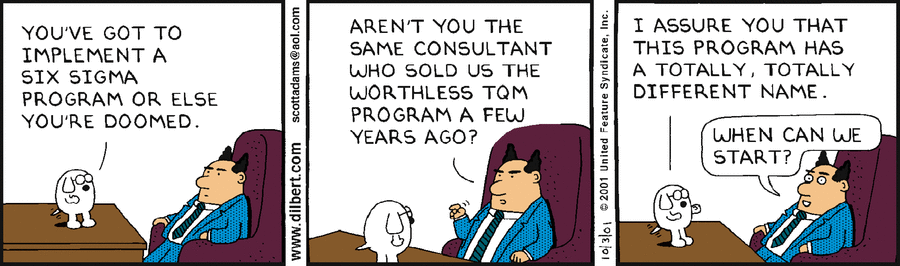
Nobody seems to study the history of these cult-like priesthoods and this particular flavour of turd polishing-on-crack, was invented in Motorola in 1986. They were brilliant and still to this day, own many of the patents for stuff inside your mobile phone, no matter which Chinese company puts it together. Infamously, they reached the promised land of six sigma with less than 3.4 variations per million and became utterly amazing, at manufacturing perfect little grey plastic boxes that nobody wanted. Meanwhile Nokia, a Finnish lumber company, started producing shiny, noisy little sparkly boxes of delight that fell apart in your hand as you bought another one. Motorola lost the greatest ever global market share in product history when Nokia teleported past, under their technological radar in 1998.
Google says it bought the struggling Motorola Mobility for $12.5 billion in 2012, primarily for its patent portfolio to protect the Android ecosystem. Meanwhile in 2004 Nokia shipped over 200,000,000 units and by 2008 held almost 40% of the global market. Shortly afterwards, the (second) iPhone turned up and made Symbian look like an abacus, so Nokia sold up and went back to sticking up the modern equivalent of telegraph poles and cashing in on all the other patents they kept under their furry Koivistolainen. Talk about preparing for transformation!
Resting your organisation’s future on a black belt no matter what the cult, can be bloody dangerous for shareholders, because the incessant turd polishing may inadvertently trigger the kind of transformation you seriously don’t want! The company in question was a specialist design house with an impeccable reputation for providing global clients with bespoke high end, luxury solutions. I wonder if they now make millions of little grey plastic boxes that nobody wants?
No they won’t be, thank god. But only because accidentally, they were as incompetent at six sigma as they were at all the other management claptrap. Don’t get me wrong, I am an expert in turd polishing myself and own several belts. There is a lot to be said for reducing waste and aligning your resources in ways that are mutually reinforcing and therefore more resilient and effective. But if you’re not careful, organisations can become so busy squashing line 10836 of the perfect project plan into the critical path, that nobody notices line 10835 was an opportunity to transform the whole organisation and the day passes them by, in the bliss of ignorance.
A little Lepidopterology
I’m sure we are now, all in agreement that you can’t keep doing what you’ve always done and expect a different result. I hope we’re also on the same page when I suggest regularly dealing with your Sociotechnical Drift, can create a healthier caterpillar and this is well worth the effort. Caterpillars actually do this in real life, shedding their skin several times as they grow and organisationally it’s a bloody useful discipline to practice every few years, but it’s not transformational.
The chrysalis represents the change process required to become the butterfly, not a different shaped caterpillar. Let me reinforce this point! Transformation is neither in the caterpillar nor in the butterfly nor in the degree of difference between them and I’ll reverse the typical definitional syntax to make it absolutely clear:
“Metamorphosis is the ability to transform oneself, when in proximity to favourable conditions!”
ComplexWales
As an organisation the ability to transform, to metamorphose, is definitely not in your genetic makeup. Many years of repetitious shouty Blahblah bouncing off the walls, has seen to that!
So it’s better to think of Transformation as being out there, not in here: you don’t have it; your strategies and plans are not it; your organisation is not transformational. The change is already out there somewhere in the landscape like the perfect branch to dangle from and when it eventually gets close enough for you to see it, you may choose to go for it, or you can ignore it, avoid it like the plague, or more likely Drift away from it unnoticed. You cannot predict it, so you cannot perfectly plan for it and you’re likely to carry on regardless, re-prioritising your turds and your visions.
If you truly want to do some transformation, you must learn how to do it and prepare your resources in advance. Regularly dealing with the Drift, by stopping and appreciating all of your social and technical assets, is definitely excellent training ahead of organisational transformation. Although, you cannot be the butterfly beforehand, you can be the Lepidopterist and dedicate time and resources to understand exactly how you’ll do it, should the opportunity arise.
In all my research as a wild changeling, I eventually had to go back thousands of years to understand how something obvious, was fundamentally different to everything else being professionally and academically thrown up in my face. If you don’t believe me, just hand some Lego to a couple of toddlers and sit back…

I have two boys, a couple of years apart and to be honest you’d be hard pushed convincing anyone they are the same species, let alone brothers. After one particular afternoon on the bouncy castle, they piled back into the house each excitedly gripping a big box of fresh Lego. An hour later and they were there, stood to attention, proudly displaying a spaceship in a hangar and some kind of giant battle robot, to a couple of equally proud parents. Aren’t they clever!
Another hour flies past and suddenly all hell breaks loose. I burst into the living room to find two boys attacking each other with disgusting piles of soggy crap all over the place. In the middle of the room, and I kid you not, was a castle with a working cannon and a medieval style trebuchet they’d created from the same Lego, to attack each other and my soft furnishings. Their arsenal of projectiles was manufactured by ripping up the instruction booklets and chewing them into sticky cannon balls, before launching headlong into the best time of their lives.
They already had the capability within their imaginations and at their fingertips, to radically change their little world and they knew it. But it was the decision to do it, that was transformational.
I can explain how they and you can do it, if you like. It’ll involve a graph and some wiggly lines and an anagram and a few of the things I’ve been poking fun at, for the past 10 minutes! #HAPTiC
 complexwales.com
Leave a comment